Saturday, 14 October 2017

Himalayas One: Manali

14/10/17 Manali Towns

From the temple, Old Manali evening

New Manali is booming, hotels and holiday apartments are going up everywhere, steadily filling in the skyline to block all but the highest peaks such as Nasogi and Bashisht that still dominate the sharply rising valley. For the last couple of hours daylight we explore the surrounding park; paths winding under a giant conifer forest canopy and amongst glades strewn with huge glacial dumped boulders. In a clearing we arrive at an unusual temple: wooden framed construction with steep teepee shaped granite tiled roof within a round outer pitched roof. The doorway and beams are carved with figures and all around the outside hang horned skulls of Ibex, blue sheep and other mountain animals. Stooping through the doorway into the surprisingly small, thickly plastered interior that muffles all the outside noise, I find a simple shrine dug under the floor in one corner, opposite is a fire pit and in-between the two sits a plain dressed man amongst an arrangement of brass dishes of dye powders, grains of corn and puffed rice, orange marigolds for people to buy and make offerings of.


We walk another kilometre or two, crossing the river to old Manali. Steep streets wind past hippy hangouts, chill zones, cafes offering real coffee and agents selling trekking tours each pumping out there own solemn variation of a Goan trance beat. Real coffee and chicken burgers can wait as we push on into the oldest part of town where some of the traditional half timber long house type buildings with jettied second floors still remain, all be it amongst the concrete new builds and extensions that seem to be smothering the valley. Livestock occupy parts of the long houses and loose hay is stored in the upper parts of some, or in separate ricks neatly billowing out between the wooden beams on all sides.


We reach the temple at the top of the village and look out over the rooftops at the awesome peaks beyond, changing blue to ochre and deep orange as the clouds spill over, the sun drops behind us and the crisp cold air rolls in.


15/10/17 Rhotang Pass


Prayer Flags, Rhotang La

Start the day with omelettes, two eggs beaten in a metal cup with milk, onions, salt and chilli; fried on a gas stove with four pieces of bread soaking up the mixture, folded up and served on a paper plate with chia, cooked one at a time by a smiley street seller as we enjoy the cool morning air. After we hire a car to take us up the Rhotang Pass, 3978 metres up, gateway to the high Himalayas. Beyond here I imagine true wildernesses existing in legendary places like the Spiti valley, territory of wild blue sheep and the almost mythical snow leopard or beyond the next, much more treacherous pass, Rangcha La, a few miles on where landslides and avalanches cut of the civilisations beyond for much of the year. Halfway up, our driver points out a tunnel under construction that will bypass Rangcha La making the outlying region easily accessible when it opens next year, surely this will have a revolutionising affect on the region.


Looking into the Chenab River valley; snow coming down.

In truth the Rhotang Pass is far from this kind of isolation and adventure, but a popular attraction for Indian tourists, who pile out of cars in 1980's onesie ski suits and long fur coats, hired on the roadside for a couple hundred rupees. There are chia sellers, offers of rides on a mule or photos with a yak, but most of the visitors aim for a selfie in a snowy scene, in complete polarity to the landscapes where most of them have come from elsewhere on the subcontinent. As slightly eccentric looking Westerners with easels, paints and drawing boards we however, begin to rival this awesome backdrop in the selfie stakes. All this going on, hardly detracts from the epic panorama of deep valleys, vast peaks spun with clouds that build and fade and build with dramatic speed, sometimes clearing enough to reveal the higher peaks hidden for hours. An animated landscape, shifting, reinventing kaleidoscope, a never static, panning out on every side. We paint and draw through flurries of sleet and snow, pausing only to catch our breathe in the thin air.

Rani Nallah
Rani Nallah - Scale

16/10/17 Beas River

Beas River at the Manasula confluence

We walk up river from Manali Model this morning, over the steel girder military bridge spanning the gorge and up river from the town to where views open up towards the Solang Valley and snow capped Patalsu Peak in the North. The extent of the river torrent in wet season is made apparent by the 200m or so width of the dry boulder strewn river bed. The main dry season channel of icy clear water runs a bright cerulean blue in the pools between the torrents. The valley is narrow and wooded with mighty conifers that run up the steep valley sides. Brightly coloured farmhouses cling to the river banks and high up the steep valley on improbable terrain, precarious amongst the new build resorts and guest houses going up all around. Above the road, golden bill magpies flop from tree to tree dragging their long streaming tails, stray dogs loyally trot alongside us, dropping away at invisible boundaries. We find a way down onto the river bed, where tin roofed shacks sprawl down the banks from the road, families finding space to live below the flood line. A limping dog that tagged along a kilometre back springs in to life at the site of hens scratching up invertebrates. The commotion alerts some women washing clothes in a brackish stream at the edge of the settlement, their clothes; lime green, chilli red, fiery orange look brilliant amongst the neutral grey river bed stones. I notice for the first time, a tawny coloured cow motionless amongst the boulders behind me, a social plover reels closely overhead, griffon vultures cruise along the rising air at the edge of the ridge a thousand metres beyond. By midday it is too hot and flat bright for painting, so we wait until early evening to find a new spot at the confluence of the Manaslu river looking back up the Beas. The Seven Sisters and the 5932 metre Hanuman Tibba peak rise in the distance, snaring the first wisps of cloud seen all day, reflecting the last colours of sun light.

Friday, 13 October 2017

Delhi Rush Hour

It's 8.10pm and Delhi won't let us go. Our two taxis are jostling forward in five lanes of traffic on the Mehraui Gurgaon road, a fifth of our journey down and it's been an hour since we left Sanskriti 4km away; the bus we have booked leaves at 9.15pm. It's time for a change of plan, a quick phone call to coordinate and we divert to Haus Kaus metro station, from where we can just make the 50 minute journey to the bus station at Kashmere gate. Ground to a halt again, our drivers pulls up on the free-way, point in the direction of the metro and tell us to run, any problems call us they say.

We run between the grid locked vehicles with the flowing melee of rickshaws and mopeds, looking for a way underground. Down the escalator at the station, jam our back packs through the security -just fits, forgot my travel card, no time to cue, do what the locals do and push through to the kiosk and urgently wave notes at the attendant – it works! Onto the platform and spot the others as a train comes in and it's rush hour on the Friday before Diwali so the carriages are packed solid to the doors. When they open people push on regardless and the carriage gives way and people compress and we nearly make it but not quite, try another door. No room, We're on the verge of giving in, sweating and exhausted, desperate faces in that split second pause before the doors shut on a full carriage sealing the fate of our getaway when a gap appears and Doug miraculously steps in and I step up flattening myself enough for the doors to close, cutting of the others who mouth to us to 'hold the bus'.

The next gruelling hour on that train is a trial of contorted compressed discomfort, testing stamina and physical strength just to stay upright and on the train. In rush hour on the Delhi Metro getting on a full train does not guarantee you will stay on the train until you want to get off or that you will be able to get off when your stop comes around. This is because the density of people pushing to get off becomes a powerful force that can easily sweep you away unless you push against it. The area around the doors when this force meets the push of people wanting to get in, because no one waits for people to get off, is the most tumultuous crush area. This also where you need to be to have a choice of getting off. If were to hold the bus for the others we need to physically fight to stay by the doors and on the train to stand a chance of getting off at our stop. As we hit the busy central stations I use all my strength to resist the crush of boarding passengers, clinging to the roof rail, swaying like a battered piece of drift wood in the torrents of the Himalayan valleys we so desperately want to get to tonight. Of course everyone smiles, grins and laughs with us at the absurdity of it as we all elbow, punch and forcefully rub against each others bodies. Thankfully, enough people want to disembark at Kashmere gate with us that the torrent out-forces those getting on and we are safely jettisoned onto the platform.
Five minutes before the bus leaves I'm elected to run on ahead, leaving Doug to run with the bags. Up the escalator and I'm immediately lost, no time to decipher signs I ask everyone at every turn where the bus station is. Up and out the station onto the street, I keep asking and soon people are pointing the way before I get to them. The buses are hidden under a multi storey car park so I need this help, people keep pointing shouting when I go the wrong way. I am so literally relying on there waving arms that I end up at one point jumping over a wall I am pointed at, straight into a police man. We hesitate as he calculates my offence, sees the desperation behind my sheepish grin and with a disapproving shake of the head releases me. I speed walk a few paces out of respect, then sprint to the security. Bag through and into the concourse – I look in dismay at the departure board, I cannot decipher the Hindi script but can see the time of our bus is not there. Another man wants to help me, he wants to show me the bus but I ask him to point, only 2 minutes to go. There are bus stands everywhere but I ask enough people that I find our Manali bus pulling out and manoeuvring like they do in eagerness to leave. The conductor is still on the ground and he says no problem to waiting five minutes when I ask, knowing the others will need ten at least. My Indian phone runs out of credit, so I can't direct the others. I go looking back to the escalator, concourse, departure board but nothing, it's too soon. Back to the bus plead for five more minutes, bus driver this time, angry, 'no waiting for passengers' as he climbs into the cab. I think the conductors more sympathetic, its an eleven hour journey to Manali after all, what's 15 minutes now. Even so, I doubt he can override the driver, chomping at the bit to get stuck into the traffic.

The others must be lost, I run for one last look doubting the driver will wait, then I spot them jogging along the stands, I shout and wave, there going towards the bus which is pulling out, I run back, bang on the drivers window and he stops, boot opens, our bags are on. All five of us have made it, sweating, exhausted, bruised and unprepared for an 11 hour bus ride. After beating the Delhi rush hour however, we gratefully savour every traffic jammed, pot holed, precipitous verged, blind bend overtaking moment of the journey North to Manali. I get a call, it's our taxi driving to 'thank god we made it'.

Thursday, 12 October 2017

Delhi Birds


Black kites, Meena

Returned to Jama Masjid to look for the black kites and find out more about if and why they congregate in this area. I walk around the mosque, on each side is an entrance, each slightly different; North side is where coach loads of tourists enter, East overlooks the Bazaar where people meet and chat on the way up the steps. South is on the road where car parts are sold and the auto rickshaws park up forcing pedestrians to walk with the traffic. A teenager is chasing a younger boy around the steps with a belt then lashes out a stray dog, a beggar is ignored, a small girl slips her hand from her mothers so she can skip in and out of the unmanned security gate at the entrance. Across the road is Kalan Mahal street, mainly butchers shops and restaurants preparing mutton and chicken. This seems the most likely source of waste to attract the kites.

I head back to the South side and into the bizarre that leads away from the mosque and along the wasteland, Meena Park, where the kites are flocking. The ground is hard and washed out umber with a weak fringe of grass tufts smothered with dust and building debris. Trees on the far side shade a small group of figures. The walled bank rises 20 metres to the street, cubes of aerial laced flats jostle higher still into a smoggy smudge. A dumper vehicle is parked, a man changes into a shalwar kameez and another paces in wide strides throwing his arms in the air grinning and proclaiming his views to the sky. Children and elderly men watch me draw, discussing my progress and arguing over which bit of the scene I am currently drawing. A woman in a sari, her child perched on the wall above me, physically follows my hand from paint box to paper, leaning in and out or rifles though the pages of my sketchbook whenever she can. One word I recognise is repeated over and over around me, 'cheel' the name for black kite in Hindi and Urdu, it seems to please the onlookers that I am drawing their birds, they admire them too I think. The cheels cousin the red kite was extinct in London by 1600 and almost nation wide until the hugely successful reintroduction programme brought them back.

As I finished drawing, a man approached me who I could question about the reason for the kites and confirmed that this area was used as a dump. The dumper moves and the flock draws in, magnetised to this visual cue. The bucket is empty though and the flock moves away expanding outwards, but without disipating. I wonder why there is no rubbish on this dump unless it is specific to meat in which case the kites play an important role in the city's sanitation. And will I find out anything about the man I saw from a distance feeding the kites?

Back at Sanskriti, sticky dust of the city washed away with a bucket, I find a spot in the garden to enjoy the final glow of orange light you get here in the evenings. Still trees turn quickly to silhouettes, flecks of leaves sprinkled across the subdued sky. A crooked spindly shape breaks the silhouettes in ungainly flight. Another one a few minutes later; two grey hornbills going to roost in a tall fig tree behind the abandoned house.

Grey hornbill, dusk at Sanskriti Kendra


(Vashiel)

Wednesday, 11 October 2017

Arrival in Delhi: 8 -11 October


Ceramic sculpture at Sanskriti


Our base for the next few days is Sanskriti Kendra, a complex of art studios and museums housing collections of ceramic sculpture, textiles and everyday objects from across India. It is built on the site of an old farm like many of the neighbouring villas along the quiet wooded, and gated, road linking us to the busy Mehrauli Gurgaon road. The sounds of life along this road are always in the background, beyond our peaceful shaded enclave. We walk along Mehrauli Gurgaon road, turning left at our junction to reach the nearest village (Ghitorni) and left to get to the metro station, linking us to the city centre. The road is a dual carriageway, though the traffic makes its own lanes and often takes over the brick paved footpath as well, especially during rush hour or to go against the flow. The metro runs down the middle, raised 30 metres in the air on concrete pillars, it snakes and twists although the road is straight. Light from the sky opaque with smog glows between the pillars in the morning and turns pink in the evening. Lighting at night is from the headlights. A digital billboard flashes regular air quality readings above the road in severe red script, cows fill their bellies in one of the unofficially designated dumps where rubbish spills across the walkway. The way to Ghitorni is lined with furniture shops, before a narrow street lined with food sellers, market stalls and high adobe apartments, forks off and branches into a maze of squeezing people, motorbikes and rickshaws crossing, pushing and weaving there way through. Going the opposite way we reach the Metro station, a massive hull of concrete hanging under the snaking line. It is painted with incredible murals in fresh new paint. Between these two points the urban sprawl is contained to this highway, beyond is wood and scrub, which from the raised vantage point of the metro platform spreads several kilometres on either side. Despite the roaring energy and claustrophobia of urban life being carried along the road it feels rural, as our way is shaded by overhanging forest, in equal measures to towering concrete, green and fresh from the monsoon rains.


9th. Gurdwara. Chandni Chowk & Nai Sarak


Volunteers making chapatis at the Gurdwara

Listened to prayer (drums) continuous people walking in and out sitting in cool corners. Separate entrance into food hall. Kitchens, drawing volunteers making bread. Men cooking, transferring food between vast pots lined along gas cookers. Cook for 5000.

Nai Sarak, densely populated street every space utilised for stalls spilling onto pavement. Chai cooked under the counter of stalls, food carts along the street. Dense crush of rickshaws, auto-rickshaws and bikes. Tangled mass of cables take up the overhead room and the tall sides of the narrow street rise in a complex tessellation of terraces. Utilising this domain, only the troops of Macaques move freely, whilst at street level the crush of human life swells and floods into every space as the traffic ebbs and flows and jams.

In the evening I paint amongst the rows of terracotta sculptures outside the museum at Sanskriti.


10th. National Museum. Lodi Gardens

An amazing collection of miniature paintings at the national gallery. Spent the whole visit in two rooms of miniatures, 1st Pahaji (17-19th) paintings and the many tangent styles of the regions under it. 2nd the Rajasthan movement and it's region styles; included discovering Nidal Chand from Jodhpur, (layering of space and use of complex and calm). I find I can paint in the museum as no one stops me! so free to explore through colour studies. 2 minutes before we go I find 'Krishna peeping through the trees at bathing Radha' (Mewar, Choaka). This is a small landscape of nocturnal palms and pools painted in tones of entirely the same blue, then yellow pink figure in contrast create incredible atmosphere. Makes colours brighter more powerful. I see this later in the week on the spice market terraces: light moats fall through chinks in the canopy highlighting ochres, orange and red in the warm shadows, contrasting with the lilac walls of the quadrangle in cooler light. (I lost this spice market drawing on the way home. From memory could limit the palette at least for initial drawing and exaggerate e.g. WB for CB then W over).


Black kites at the Bada Gumbad tomb, Lodi Gardens

After the museum we went to Lodi Gardens. Peace, calm, lovers walking hand in hand. Beautiful Mogul tombs and and mosques rise above lush mature ficus trees so our discovered as we approach. Here Black kites gather on a dead tree and rose ringed parakeets nest in the cracks of the ruins. (look so much better here than West London)


11th. Jama Masjid. Spice market on Khari Baoli


Black Kites in front of Jama Masjid
In the morning we visited Jama Masjid. Climbing the steps to this mosque offers great views across the bizarres towards the Red Fort. Above us circle over hundreds of black kites – a scavenging bird of prey that soars and floats like a toy kite, using its long forked tail as a rudder. I follow the birds to the source of this mega flock, leading me through the Mosque courtyard and out the East gate. Here I look down onto a park, although it looks like a wasteland. At the centre of this space a man in a white kameez is throwing scraps of meat into the air – above him a whirling column of 500 kites rises 100 metres high. They are stacked almost, almost queuing to position themselves throwing distance from the man and catch one of the scraps he tosses up.

After this we visit the spice market at the Western end of Chandni Chowk, goods laid out on three levels of terraces inside a quadrangle. Dust form sacks of chillies, turmeric, cinnamon fill the air so that everyone breathing the air coughs and sneezes, including the sellers. A constant stream of couriers bring sack load after sack load through the narrow levels, outside the road is blocked with carts of spice. Its stifling but the visual overload is addictive – return.


Saturday, 4 October 2014

LOOMERY SCROLLS EXHIBITION

18 - 28 SEPTEMBER 2014

A drawing installation made by Chris Wallbank in collaboration with Professor Tim Birkhead for Festival of the Mind, exhibited throughout Sheffield Cathedral.


INTRODUCTION

Skomer Island off the Pembrokeshire coast, is famous for its unspoilt scenery, carpets of wild bluebells in the spring and populations of breeding seabirds in the summer. It is also the site of one of the most important scientific studies of one particular seabird species: the common guillemot. This study was established by Tim Birkhead, Professor of Behavioural Ecology at The University of Sheffield and a leading expert of ornithology who has returned to Skomer to monitor the island's breeding guillemots every year since 1972. The value of his research lies in 40 years of experience and data collection. The long term insight it presents reveals remarkable natural history discoveries of a species that can live for 30 years, returning to the exact same tiny breeding site to reproduce with the same partner year after year. The guillemot breeds at high densities on cliff ledge colonies known as loomeries, laying a single egg on the bare rock. Under these conditions they develop loyalties, alliances, friendships and rivalries which makes guillemot society one of the most complex and fascinating of the entire animal kingdom.

Guillemots are highly vulnerable to oil pollution which has been a major factor in the species’ overall decline. Skomer's population today is a considerable 25,000 pairs, but even this is a long way off  the 100,000 pairs estimated to be on the Island as recently as the 1930's. In February 2014 consistently heavy storms, the likes of which have become more common as a result of climate change, led to the death of at least 40,000 seabirds including a high proportion of guillemots. These birds were counted from those found washed up in 'wrecks' along the Atlantic Coast of Northern Europe and only reflect a small proportion of the total loss at sea. Three times the average number of Skomer-ringed birds were found dead during this period. Guillemot populations can withstand very occasional years of high mortality, but a run of them could spell disaster and the added pressures of oil pollution, on-going depletion of fish stocks and climate change make that a real possibility. Long term studies like Tim Birkhead's are vital for understanding the health of a guillemot population, but they also enable us to gauge the state of a constantly changing marine environment. It is tragic then that Natural Resources Wales has recently withdrawn the modest funding needed to run Skomer's guillemot monitoring project, disregarding the benefits of continuing this long-term study.

In 2014, for what may be the last season of the long term guillemot project on Skomer, visual artist Chris Wallbank, supported by The University of Sheffield’s Festival of the Mind, travelled to the Island to draw the loomeries that form the basis of Tim Birkhead's research. Wallbank worked on a large scale, necessary to capture the impressive size and formation of a loomery with enough detail to describe many of the individual birds and behaviour that the monitoring project focuses on. His method was to observe with a telescope, panning through the mass of squabbling, preening, copulating birds, unrolling and re-rolling a large paper scroll as the drawing progressed. The resulting work exhibited around the cathedral, tracks the changing dynamic of Skomer's Loomeries throughout the breeding season. Made from direct observation and informed by Tim Birkhead's insight into guillemot society, close examination of these drawings reveals the order hidden within Skomer's spectacular loomeries.


THE SCROLLS


BULL HOLE LOOMERY, 9 - 10 MAY

The guillemots in these drawings have recently returned to breed at their loomery located on the scree and gullies that cascade down the cliffs of a precipitous inlet on Skomer Island known as bull Hole. It was early spring when this drawing was made, but Bull Hole still roared with the surge of a long fetching Atlantic swell and winds gusting over 40 knots. Even this storm however could not drown out the raucous chorus of the thousands of guillemots at the loomery on the other side of the inlet. Their breeding season had begun and the whole colony  buzzed with social interaction as returning birds re-established old territories and reinforced bonds with their partners and neighbours. Guillemots are capable of great tenderness towards one another, developing friendships which at the very least serve to strengthen a loomery's cohesion and its defence against predatory gulls and ravens. Displays of aggression between guillemots are nearly as common in the loomery and squabbles over territory frequently erupt into brutal fights. This is particularly true at the beginning of the season when males desperately attempt to steal copulations from the partners of other males.


The loomery at Bull Hole was the focus of Professor Tim Birkhead's research when he first arrived on Skomer Island in 1972. In the lower part of the left hand scroll it is possible to see some of the artificial slate ledges he and his student Ben Hatchwell installed to enhance breeding success at Bull Hole. In these early years of his Skomer research the island's guillemot population averaged 2000 pairs, a fraction of today's total, now in the region of 25,000 pairs. This increase in guillemots on Skomer bucks the trend, because most of the UK's breeding sites, particularly in the Northern UK are in decline. Read posts on making Bull Hole Loomery here.

Bull Hole, detail


THE AMOS LOOMERY 16 - 18 MAY 

In this scroll, many of the guillemots can be seen incubating eggs, a marked transformation from the Bull Hole drawing made just a week previously when no eggs had yet been laid. Guillemots at a loomery are synchronized in their breeding, so laying tends to occur at the same time. This synchrony enhances the value of dense breeding groups which form an essential barrier against avian predators of eggs and chicks.


The loomery in this drawing is found on an elbow of volcanic rock folding out to sea known as the Amos which has been Professor Tim Birkhead's main study plot colony on Skomer since the mid 1980s. Every year towards the end of the breeding season Tim Birkhead and his team mark about 300 of the Amos guillemot chicks using uniquely numbered colour rings. As guillemots return to the same spot to breed every year Tim Birkhead has been able to build up a database of life histories from the observations made of these colour ringed birds. Being able to recognise the returning birds in this way makes it possible to monitor factors vital for assessing the health of a guillemot population such as adult and immature survival, breeding success, timing of breeding and the chick’s diet. Any of the colour ringed birds seen by Chris Wallbank as he drew the loomery are included on this scroll along with their history. For example there is a yellow ringed bird Y366 at the bottom right corner which the data reveals has been returning to the Amos to breed for 14 years. It hatched at a nearby site in 1993  making it the oldest bird identified in these drawings. Read a post on making The Amos Loomery here.

Detail of the Amos showing some of the colour ringed birds

Notes taken from the monitoring project's database, correlating to the
colour rings recorded in the drawing


ELEGUG, 15 JUNE

There was no text accompanying this scroll in the exhibition. It was made with brush and ink over a single sitting at a South Pembrokeshire coast site where the guillemots form very dense loomeries on top of sea stacks. The piece was an exercise in shorthand, using calligraphic characters to describe the multitude of individuals as a whole. Read a post on making Elegug Cyfnos here.


TIME LAPSE, WICK LEDGES 20 - 21 MAY 2014


In these scrolls, Chris Wallbank has drawn the same ledge repeatedly over several hours to produce a time-lapse image that records the changing dynamic of a loomery. They are drawn after the main laying period on Skomer, when guillemot pairs take it in turns to incubate the egg, relieving one another to forage and feed at sea. During this period the density of guillemots on the ledge rises at certain times of day, usually early morning and late afternoon when the pairs swap incubating duties. This process known as 'change over' can often be lengthy, since the incubating bird is usually reluctant to move off the egg and needs to be persuaded through long reassuring bouts of allopreening combined with gentle nudges that become firmer as time wears on. Despite breeding in incredibly close proximity, in some cases up to seventy breeding pairs crammed onto a single square metre of ledge, guillemots are able to recognise their own egg because each one has markings unique to the female that laid it. This results in an infinite variety of colour and pattern occurring in guillemot eggs, ranging from dark turquoise to pale orange, wispy streaks to heavy blotches and spatters, as can be seen in the long ledge drawing here as well as in the Amos scroll. Read post on making the time lapse scrolls here and here. 


LAND - LOOM - LEAP

 Land - Loom - Leap, guillemots landing and their fledgling leaping from an imagined loomery to form a repeating pattern on a 4 metre long hanging scroll.   

The guillemot young leave the colony around 21 days after hatching. Although barely one third the size of an adult and still unable to fly the young jump from the cliffs, often falling hundreds of metres to the sea below. The young, make this leap of faith with encouragement from their fathers who calls to them from below. On the breeding ledges they were vulnerable to avian predation, now at sea they stand a better chance of survival, diving under the waves and staying close to their father. They remain at sea with their father for two or three months until fully fledged and it will be a further two years at least before they return to Skomer and a further five years after that before they attempt to breed. 


OPTIMUM BREEDING SITES


After the young have fledged Female guillemots remain at the loomery for some 14 days defending their territory and laying claim to the breeding site for the following season. Professor Tim Birkhead's research on Skomer has found that the optimum breeding sites for guillemots are on ledges where the greatest density of birds can occur. In this scroll Chris Wallbank uses colour to offer an impression of where these 'hot spots' might be found on Skomer's Amos loomery. Of course the paradox for guillemots seeking such optimum sites is that they are protected from imposters as well as predators by an alliance of neighbouring birds. How guillemots decide which ledges to colonise in the first place is more of a mystery, although watching guillemots re-colonise Skomer since the 1970's, Professor Tim Birkhead has noticed their loomeries grow into the same formations as those seen in photographs taken on the island 80 years ago. 


This project has been made possible through the support of The University of Sheffield's Festival of the Mind and Sheffield Cathedral. Special thanks to The Wildlife Trust of South and West Wales, Shenaz Khimji and Skomer researchers Elspeth Kenny and Julie Riordan  for their assistance with the Loomery Scrolls project on Skomer Island. 

Tim Birkhead presenting a lecture on his research at Sheffield cathedral
during the exhibition

Thursday, 17 July 2014

ORCA Survey to Svalbard on the Saga Pearl II


Between 22 June and 6 July I took part in a marine mammal survey for ORCA on the Saga Pearl II as she cruised North as far as Svalbard. The drawings below were made whilst on half hour breaks in surveying and brief moments ashore in an attempt to capture a sense of the breathtaking landscape and abundant diversity of wildlife during my first encounter with the Arctic. 


North Sea


The North Sea tested our endurance as surveyors, we were faced with rough seas and an ever strengthening wind chill as we headed further north towards horizons studded with the contorted steel frames of oil rigs. A brief stop in Stavanger offered a glimpse into the affect of this industry on a booming Norwegian economy. Layers of old and new; the old town with it's fish canning factory and wooden houses sandwiched between a skyline of modern blocks of flats and a sea front dominated by the mammoth hulk of oil ships.
It's another day out of Stavanger and our forth day into the survey before the first shout of 'sighting!' ends the long wait since leaving Dover. Two fin whale roll in front of the port bow, the hanging blows whipped away in the north wind as fast as they exhale and they are gone. It is 04.40 June 26 and at 67 degrees North we had crossed into the Arctic circle. Here the Gannets that accompanied us further South have been replaced by fulmar and kittiwake gliding effortlessly on the ships updraft. The direct and purposeful flight of foraging auks such as puffin and Brunnich's guillemot contrast the fulmars euphoric movement dissecting our passage in ever strengthening numbers as we approach land. Soon after we arrive at our second port of call Leknes in the Lofoton Islands.
That evening we skirted the stretched Archipelago and in the calm southern lee of the land picked up further sightings of harbour porpoise and minke whale, their subtle presence on the surface given away by the disturbance of a bait ball. The evening ended with our first sighting of Orca, a sign of things to come.

Nordic Sea

We surveyed all the day of the 27th on deck as we crossed the open Sea that separates Svalbard from Norway. Sightings ranged from early in the morning with an amazing three separate counts of large pods of orca within a couple of hours, the tall black upright dorsal of the big bull males unmistakable on the horizon. Although all these views were distant, around 2km away and viewed in the binoculars, the ferocity of these animals could be recognised in the way their sail like dorsal fins quivered and reverberated with a force that belied the power of their thrashing movements under the waves.
By midday sightings of orca, minke and white beaked dolphin had been replaced by the visible blows of the largest whales. A quick look at our position confirmed it, we had crossed over the land shelf and into the deep water where the ultimate megafauna thrives. Fin whale sightings were in abundance now, but also present were the rarer seen sei whale, which due to the confusing similarity between both species in the field presented one of many id challenges for me. I was however fortunate to have several sightings of sei whale, some even in close association with fin whale and was able to discuss each with fellow surveyors, Paul Burley, Kathleen Neri and Rachael Barber. I learnt first hand to distinguish the shallow surfacing sequence of the sei compared to the prolonged roll of the fin and the diagnostic but subtle difference between the dorsal of each species.
Soon we catch sight of distinct angled blows and closer encounters confirm sperm whale logging on the surface and occasionally with luck we catch the dramatic display of a fluking tale as these true giants of the deep point into a dive heading one, two thousand or more metres down. Perhaps the most memorable sighting for me that day was another personal first; the cue was as normal a blow near the horizon caught in a scan of the binoculars then more unusually a big splash which at over a kilometre away had to be caused by something big. Then confirmation, a tall white flipper rising straight above the duller white caps before crashing down heavily on the water, again and again, unmistakable, a humpback whale! Okay, it may only of been a dot on the horizon but it was an ambition realised and I could even make out the characteristic fin slapping and breaching behaviour.

Svalbard: Isfjorden and Longyearbyen    


On the morning of the 28th the view from deck is of calm waters reflecting monochrome contrasts of dark rock and white glaciers surrounding Isfjorden, Svalbard. The mirror smoothness is broken only by the occasional scuffing of a wind pocket, a cluster of little auk rafts and the slap slap of paddling wings as brunich's guillemot scuttle away from the ship's wake. That is until  the slick dark shape of a whale arches silently out of the water, the body silhouetted black but glinting a brown almost gold where it catches the light. There is no distinguishing  blow but a swept back dorsal suggests a fin whale. We pass two more fin whale in the fjord, all swimming shallowly it seems with few visible blows.


On land we hike up the Longyearbyen valley to the edge of a glacier where we find fossilised plant material in the rocks scattered amongst the moraine under foot and hear the wonderful call of little auk on the colony ledges high overhead. On the outskirts of the town but within the permitted safety of its perimeter (beyond is polar bear country), boggy tundra holds a wealth of bird life; eider duck nesting in the safe shadow of the husky kennels, brackish pools on the side of the road attract purple sandpiper and the grey phalarope which is in fact a deep rusty red here in its breeding plumage. There are barnacle geese on the estuary and the mountainsides whilst Arctic-turn defiantly guarding their nests are a constant hazard even in the most built up areas.

Fossil leaves

Svalbard: Ny-Alesund


Undoubtedly Ny-Alesund was my favourite land day, our Captain Wesley Dunlop had secured a long stay at port until 11pm and with sunset not due for another month at least, I had time to explore and sketch. The painting above is of the peaks and glaciers surrounding Kongsfjorden from a beach below where the Pearl was moored with the small town of Ny-Alesund behind me. The day was still, sunny and mild and with the air incredibly clear views appeared bright and sharp.


Anyone who had not seen a whale from the Saga Pearl II up to this point, had done so by the end of today because kongsfjoren was being patrolled by a single humpback whale for most of our stay. Not only could we see it as it lunge fed, surfacing with bulging pleats ahead a tell tale sequence of bubbles, but it was possible to hear the exhalation with every surface. Also audible was the loud cracking of the glacier it fed below, diving repeatedly around a large ice-flow dotted with resting terns. Eventually it entered the centre of the bay and closer to the town, which is when I drew the sequence below before it finally swam towards the open sea passing close off the Pearl's port-side to the delight of everyone on-board.


Svalbard: Magdalenefjorden


At almost 79 degrees North Magdalenefjorden is our most Northerly destination after which we begin the Southward journey home. The fjord is a large horseshoe bay surrounded by formidable mountains rising steeply and immediately from the waters edge.  At the Eastern, opposite end to the seaward entrance a large glacier feeds ice flows into the bay; drifting jewels of refracted blue light in a monochrome landscape.


The scale of this landscape is immense, almost incomprehensible and my instinct is to put my binoculars to the mountain slopes to search for a recognisable detail that might give me better bearings. But nothing is familiar here and I am again astounded as I focus my binoculars on an apparently barren slope of ice and scree to find it teeming with life. Clouds of what seem like insects in their hundreds of thousands swarm on and off the slopes, a quick adjustment of scale and I realise I am looking at a vast breeding colony of little auk. It is possible to just make out the auks in this picture represented as tiny groups of dots.
Whilst I paint the little auk colony, Paul picks out distant walrus in his scope for people to see. Just before we leave at midday I have to train my scope where he is looking, far far away I can just make out the bulk of walrus hauling themselves onto a beach, though they are hard to make out I am very pleased to be able to draw the first walrus I have ever seen.


As we depart, the Pearl passes closer to the walrus and from a new angle we can just make out approximately twenty hauled out on top of one another. After this we start to pack up ready for dinner when there is a shout, someone has spotted movement in the water, we rush to starboard to see a group of walrus swimming in a porpoising fashion. They move fast in a tight group that seems to rive with blubber and tusks in a wild frenzy. What seems like panicked behaviour is in fact typical I am told and not just a reaction to the ship; travelling in tight packs in this way to me seems an effective way for the walrus to deter aquatic predators.
We pass through the mouth of the fjord into a heavy sea. After an hour or two surveying in unproductive conditions of sea state 5-6 we notice a band of calm water on the horizon, we cross this visible divide and as if by some sudden enchantment the sea state instantly drops from 5 to 1 and then zero. Along this boundary we immediately pick up sightings of porpoise, minke and white beaked dolphin and then continue with more and more sightings of blows sometimes accompanied by the role of a fin whale or hump back. Amidst all this, the level of excitement is suddenly turned up when amongst a trio of blows Rachael notices something very different, I rush over from port side and get onto the blows as she confirms it, a blue whale! along with two humpback and a fin whale.

Blue whale

The most unexpected sighting of the trip was of harp seal travelling in packs sometimes several hundred strong. The video below is of one of several of these travelling packs.


Barents Sea

Heading South again on July 1 we traversed the Western edge of the Barents Sea. For most of the day we followed a land shelf where deep water upwhelings provide conditions for nutrient rich habitats that sustain the top predators we hope to catch sight of. The water boiled with the tell tail sign of bait balls, prolonged scrutiny of which was rewarded with the sight of minke whale patrolling the corralled fish. Further out in the distance the horizon was interrupted by regular blows from the large whales feeding along the deep water drop off; fin whale 14, Sei whale 1, hump back whale 5 and other unidentified rorqual whale totalled 15. At one point a fin whale blow caught the eye at 4km or so, a flash of white that dispersed quickly, but then behind it something different, a blow that began to rise and rise until it broke above the horizon, a vertical jet of water powering straight up and reaching a height that dwarfed the others before it. The volume of water must of been immense because it kept powering upwards before a second slightly weaker but equally tall blow refreshed the drifting cloud of vapour marking the distant spot. By now some of the other observers were onto it, it had looked like a blue whale blow, we watched the approximate patch of water as we passed closer hoping to glimpse a view of the giant, but the moment slipped behind us as we steamed on ever southwards. 
More conclusive was the view of this fin whale which I was able to draw as it passed at one point no more than one hundred metres off our Port bow. It had been the most incredible day of surveying with little let up on sightings, many now engraved onto my memory especially that tentative glimpse of a blue whale blow erupting silently on the distant horizon.
  

Off Nordland

The next morning, July 2, we docked in Tromso after which our onward journey took a course through the narrow fjords before emerging into the open water of Vestfjorden, South of the Lofoten Islands. In the fjords we only sighted small Cetacean; porpoise and white beaked dolphin. Bird highlights included a very distant soaring white tailed eagle, Arctic and great skua, eider ducks and Arctic tern for whom nothing is to big to take on when protecting a nest, even our ship which they would mob without fear if it passed too close.


Long finned pilot whale

We woke on the 3rd in Vestfjorden with conditions a perfect sea state 0-1, mist hung threaded between scattered islands and below the snow strewn massifs of the mainland. There was the faintest orange glow, suggesting a mellowing in the sunlight that until now had been relentless. The water rolled silver and smooth so it was easy to pick out the distant black shapes of long finned pilot whales. For several hours we traversed the coast and this tranquil scene remained as we picked out the forms of more pilot whale, white beaked dolphin, minke whale or porpoise silhouetted in the mirror calm.


By mid morning land was out of sight and the wind strengthened as the sun rose. As the sea state deteriorated sightings became more infrequent, but there was one more surprise in store as Rachael picked up the unmistakable quiver of black dorsals on the horizon. Orca! and this time we were on a direct course to pass close to them. Everyone on the sun deck were able to hone in on the dark shapes of ten dorsal fins rising out of the water in staggered formation. As the distance between us and them closed, the white patches around the face of each Orca became obvious as they surfaced. Passing them on Starboard the biggest bull male (there was at least two in this pod) suddenly erupted into a display of breaching and tail slapping.
That afternoon we hit a long distant swell pushed on by a deepening low off Iceland to the West later accompanied by heavy winds and a sea state 6 which puts an end to our day's survey.

Final Ports


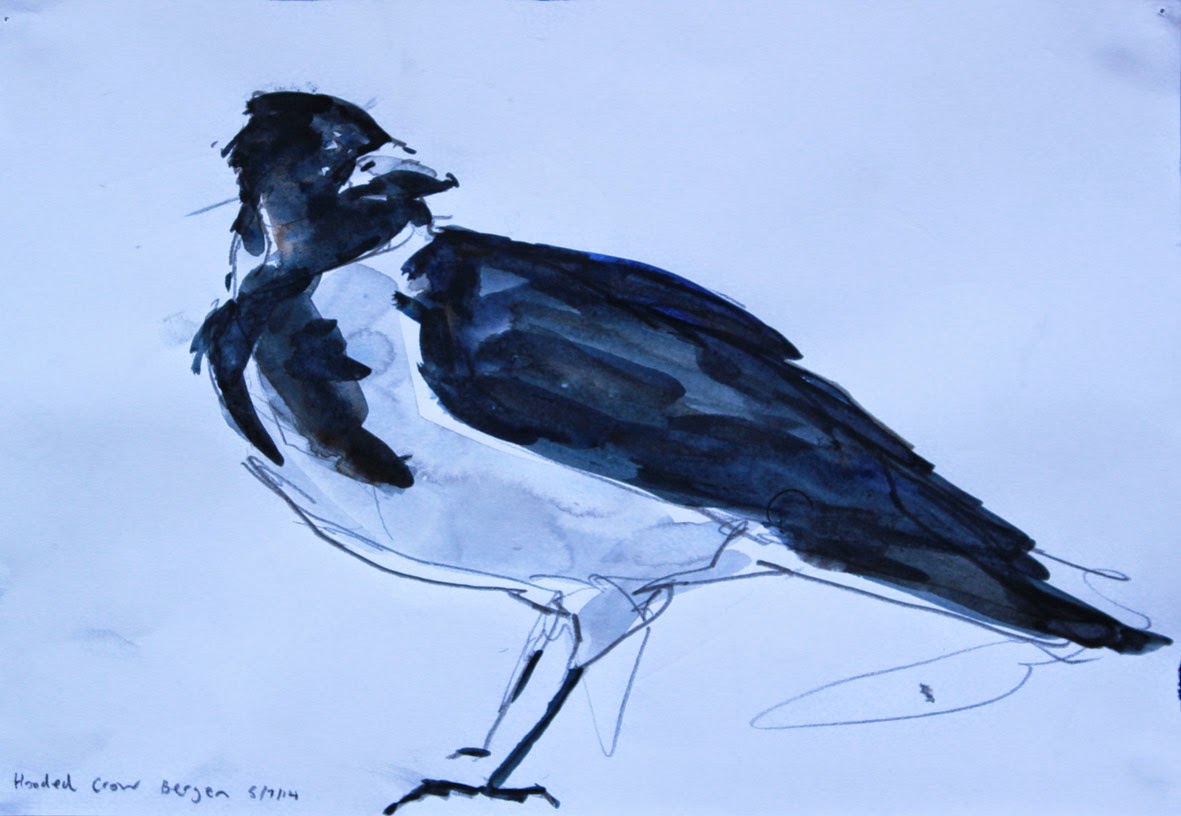
In the days that follow Saga Pearl II navigates an inshore route similar to that of the famous Hurtigruten. We find ourselves often amongst jaw dropping scenery of fjords fed by free falling waterfalls emerging from a carpet of forest at the base of dark massifs; serrated ridges, jagged peaks and snow filled cols. It is the perfect place to recover and reflect on our journey into the Arctic, although we continue to observe finding the fjords rich in life, especially recording incidental sightings of porpoise frequently. It is pleasing that after all the big and showy animals of the deep, everyone on deck is just as keen to scour the waters in the hope of glimpsing the brief splash or role of these more diminutive of cetacean. We visit Geirangerfjorden, the archetypal picture postcard scene, before heading on to arrive in Bergen. In Bergen I entertain myself drawing hooded crows, coxed down from their perches with crumbs of 'the best in Norway' Skilligsboller, a cinnamon bun I didn't think much of, but I needed to get rid of my kroner on something. The final voyage on the 6th took us back across the North sea in rough conditions producing few sightings, although that night I am happy to see darkness fall for the first time since our departure two weeks earlier. The following morning we a greeted by brilliant white cliffs on a sunny day in Dover.   

Fulmar in the wake of Saga Pearl II