|
|
Winter thrush began to arrive at the beginning of the week, with around 1000 fieldfare at Clywedog on Sunday evening. By Wednesday a massive wave of 2000-3000+ were moving down the Gilfach valley stripping the mountain rowans at an incredible rate. Feeding frenzies could be spotted far off because the trees seemed to vibrate and splinter as the birds scrambled around the branches filling their crops. Flocks the length of the valley moved in paddling flight over the hill tops, then swooping low over my head, around and again like a conveyor of birds stretching for miles. Flocks would break off, switch direction, scout and foray before the current of movement would break and birds fall out of the sky, descending on one of the red berry laden beacons lighting up the hill side. The harsh clacking calls of the fieldfare became ambient sound throughout the valley, whilst silence became disruptive as it usually precluded an eruption of alarmed birds disturbed from feeding by ominous shapes in the sky. With the sheer number of birds in the air I found it impossible to spot the threatening silhouette of a raptor at such times although plenty were about, buzzards and kites seemed to congregate and of course peregrine and sparrow hawk, lurked in the wings.
 |
|
It took me most of theses first few encounters to learn how
to approach these birds and in terms of drawing to ‘get my eye in’. Getting
your eye in, is about becoming familiar with a subject so as to draw it
intuitively. For me a lot of this is to do with understanding what is
achievable, for example, here the birds were constantly moving especially while
feeding, but I learnt that they rested at certain times in clusters at tops of
trees allowing there forms to be studied in drawings I aimed to complete in
about 30 seconds. I could build up the groups and begin to form compositions of
natural posture. Crayon or pen was best for this rapid movement as marks had to
be definite deliberate, as such drawings rely on split second decisions.
Numbers at Gilfach peaked on Thursday as the birds funnelled
through the bottom of the narrow valley and gradually dispersed along the wide
track of the Wye and beyond perhaps into the Elan valley. On Friday a hillside
near Tylwch, laden with red Rowan trees became the focus, I had the best success
here because the steep slopes accessed by a sheep track afforded great views
from the cover of trees still in leaf ( cover from above seems most important
as the birds scan from the air to ensure it is safe to descend). By the end of
Friday the original number of 1000+ fieldfare and redwing with five times more
starling began to dwindle as a pair or more sparrow hawk striked the flocks. By
Saturday it was not worth waiting as the birds could no longer feed, since a
raptor would be waiting for the opportunity, plunging into a tangle of wings
and branches every time a group dared alight. Also of note a group of 22 raven
playing on the ridge, possible goshawk and first brambling of winter.
Many drawings were scrapped to begin with but as the days
progress I developed a kind of short hand for theses birds, so I can now at
least visualise drawing more challenging numbers, movement and behaviours such
as the incredible acrobatics performed when feeding that lasts only a few
seconds. Two ideas emerged this week, firstly the drawings which I have
discussed above which, as I originally planned, can be worked into monoprints
(when I get back). Also I have enough material to paint the flocks in the
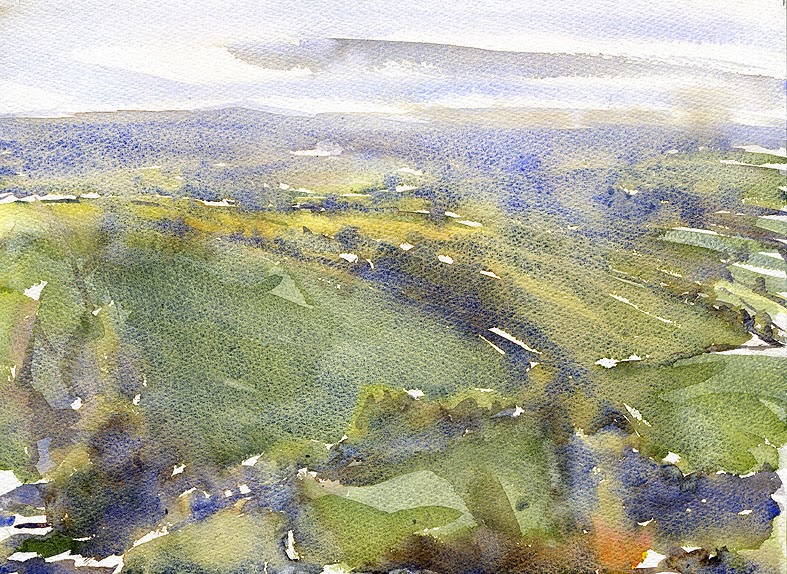
stunning Gilfach landscapes. Several compositions in mind especially this
mountain side which I sketched yesterday evening as the rain began to pour,
sometimes this helps explore colour and definition since the work is constantly
being washed away and applied over and over in a kind of evolution. End result
not much but a useful exercise to loosen up my landscape. (um, ru, az, cy, bs)
This mast year, means lots of rowan still left on the hillsides, so with luck
and another easterly to bring a new wave through there will be more opportunity
to draw these birds and the exciting occasion of their arrival.