Monday, 6 November 2017

Rural Modinagar

03 November 2017

Modinagar has grown up spreading along the length of the Meerut highway. A short walk North away from the road leads into quieter, domestic streets, mothers and sisters in doorways, children on bikes, cakes of cow dung drying on thresholds ready to fuel the cooking fire. A little further on, the houses stop as abruptly as they began along the crush of the highway and are replaced by fields. The road begins to meander, bullet carts slow their pace right down, creaking in time to the sway of the buffalo's hips.

The fields of double overhead high sugar cane are ready to be harvested, other fields already bare are ploughed ready for planting wheat. Some are furrowed dusty brown, others recently irrigated are rich with clots of purple black earth. This patchwork of colour is neatly stitched together by a web of leats designed for running water from a well prominent in the distant flat landscape. The narrow raised banks of the leats also carry people through the countryside from field to field, balancing on the crumbly soil like tightrope walkers.


Off the road I come across a field of sugar cane being harvested by six or seven women (they come and go). They are stripping the leaves and bundling them up, these are carried away where I think they are used as fodder for livestock. I sit on the verge drawing until one comes over and we communicate through mime, she is warning me of snakes so I move to the ploughed field where she says I'll be safe. Turning to move I see a 2 metre snakeskin shed in the ditch amongst the scratchy dry foliage. After I finish my drawing, I meet Ashok whose family owns the farmland I am on and we eat the sugar cane given to me by one of the workers. This cane field is 100 hectares he tells me and that it is normal for farms to be 1000 ha or more in India. They will of harvested this field in ten days.

I walk along the leats where I find a spot that seems to overlook the decide between industrial town and country. A family gathers brush wood, expertly transporting it along the narrow leat paths. The father squats and watches me paint form start to finish in complete silence. Later I head back to the road where a man is flooding his field from the leats. Metallic grey water calmly fills the ploughed furrows advancing towards where I stand pushing ahead of it a tide of white cattle egret, greedily feeding on fleeing insects. A drongo perches on the wires above with kingfisher and the egret are around my feet. I am joined by a large group of children, the only drawback to this peaceful location being the constant entertainment and fascination I provide to the residents. Meet S and finish the day drinking chai with his family in a beautiful farmhouse.


Saturday, 4 November 2017

Teaching Week 1


Friday 27th Icebreaker with Foundation: Drawing Portraits

Teaching at International Institute of Fine Art (IIFA)

Monday 30th: Painters
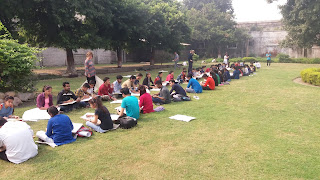
2nd and 3rd Years

Intro to Figure Drawing
Drawing figure as whole (moving away from head to toe outline). Discussed this in relation to weight and posture, looking at Goya drawings. Rembrandt ink drawings in discussion of economy of line. Practically encouraged students to look at connections or 'invisible lines and angles' though the body to rapidly find the form. Doing this while emphasising weight and effect of gravity with importance of grounding the figure. Using charcoal for many different marks (not heavy outline).


Tonal Drawing. Used lighted brick to introduce drawing without lines; looking for contrasting tones, edges not lines. 30 minutes drawing figure, naturally began to include interior in drawings.
Figure in Space. Drawing the room - then introduced model. Discussed e.g. plains of figure matching room, space in extreme foreground in one students work (who had added page) created sense of sharing the space (words used: intimate, artist's view point) (re. Tim Hyman).


Afternoon. Working on single large drawing outside. Chose backdrop at end of road, old factory gates overgrown weeds and rusted up truck. Asked students to think about including whole space in drawing (using thumb nails to plan - seemed not to have done before) . Introduced figures one at a time in different areas of scene. Often extended pages. Encouraging to loosen drawing, rework drawing, use mark making and more tonal variation, think about spaces - calm/busy and breadth of vision i.e. peripheral.


Tuesday 31st: Foundation
Groups B&C in Morning. Group A in Afternoon


Introduction to Figure Drawing
Similar introduction as Monday class, followed by longer tonal drawing. This done by covering model with sheet to give basic shape defined tonally. Sheet removed and students tasked to render their figure over tonal figure.

Wednesday 1st: Applied Arts
2nd and 3rd year

Character Portraits
Class set up in circle, students take turns to model two at a time in centre. Using ink and brush on an A1 sheet divided into 16 A5 sections for each portrait. Focusing on ways of drawing, use of media, marks, design and composition as means of visually communicating a message about the sitter i.e. personality, character. Once students got the hang of this, we introduced a charades type exercise where each sitter chose a piece of paper with a characteristic written on it which the students then had to communicate through their drawing. Each time we discussed the characteristic, asking for words to describe it and then a Hindi translation, sometimes encouraging the students to direct the pose in an appropriate way. Final exercise was a full figure drawing based on an event chosen at random, introducing students to using the space around the figure to build atmosphere.


Sunday, 29 October 2017

Rooftops

Modinagar factories, late afternoon.

From the roof I look over Modinagar station directly below and out across the maze of angular rooftops dissipating into a milky haze of morning smog. Macaques rummage unseen, deep inside the crowns of fruiting trees. A train pulls into the 1000 metre long platform, cutting off the flow of pedestrians on the line. People climb into the open doors and disappear into the windowless carriages.

I cross the roof to the West, climbing between a web of cables, through narrow doorways, along terraces and around rusted cages built over satellite dishes and skylights to keep off the macaques. Drains clog with green algae and another is full of old light bulbs that crunch under my feet. Concrete turning to rubble and dust mixed with guano cascades down the walls, collecting on sills, ledges and the broad leaves of garden creepers grown wild below.

To the West I overlook the sugar mill; decorated lorries, bullet carts and tractor trailers loaded with sugar cane form a cue below. Macaques clamber, unseen on the high loads nonchalantly chewing on the cane, an easy target ( I have seen pedestrians in town steal a stick from the slow moving tractors as they cross the road, gangs of school boys snap canes on their knees, the unsuspecting victim rumbling down the road behind them). Pure white egrets pick amongst the empty trailers and heavy machinery, looking for insects, small mammals and reptiles. A family of mongoose weave in and out of corrugated shacks built around a giant silo. The convoy of sugar cane snakes around this silo and into warehouses where cranes transport the sugary loads into the dark recesses beyond. Above, more silos rise amongst a network of overhead pipes. Chimney stacks reach even higher into a static clot of yellow haze.

In late afternoon the sun hangs above the factory, a visible disk smothered by smog, an orange crescent around it, purple brown below. Macaques troop through the factory in a long procession appearing and disappearing over rooftops as they travel into the distance.

As night falls on the 31st, the convoy into the factory is double thick snaking out the gates into the main road. Lorries hidden from above by the gigantic bundles, spindly canes piled high and overhanging. Macaques clamber over them, bathed in phosphorescent light. A boy washes clothes on the pavement below, men mill around, a bullet cart starts rolling, the farmer takes a running jump onto the edge of the cart whilst examining his bill of sale he carefully folds it into his pocket and pulls at the rains of his buffalo. The factory is lit internally, the workings now visible, mechanical claws lifting cane and piling it high in the yellow glow. Vertical sheets of shadow beam into the night sky. Techno rumbles out of the streets beyond the railway, mingling with the workers radio station punctuated by the clang of metal claw and woody cascading of cane.

Tuesday, 17 October 2017

Himalayas: Trithan Valley


Shrine to Shiva
18th. We stay four nights in the foothills. Steep sided wooded valley, fiery yellow hillsides, terraces climbing high, crystal clear river below depositing granite beaches and boulders. The road runs along the Southern bank, our home-stay is on the North side serviced by a zip-wire with a hanging basket that you can pull yourself across on. Well trodden footpaths lead up in every direction, weaving between terraced maize and orchards. They link the farmhouses together, the highest must be several hours walk up very steep terrain. 200 metres up from our home-stay the path leads us onto the porch of one old farmhouse built into the hill, a bright green wooden veranda jutting out on the first floor, supported by simple wooden pillars and clad in red panels. The walls are lime wash, heavy granite tiles on the roof and a small shrine just visible under the eaves. A larger shrine is on a terrace above the house, green painted wooden frame on a stone platform supports a roof. Underneath the roof; offerings of grain, flowers and gold woven material are arranged amongst more permanent calved figures, tin metal snakes nailed to the eaves and rows of iron tridents on the outside. People pass by this family house and shrine as the path network runs from house to house through one another's backyards. Many carry maize or the papery leaves stripped from the cob used as cattle fodder. Many stop to talk, one mentions the shrine dedicated to Shiva, recognisable in the weathered carved tablets leaning around the shrine platform, they look ancient, older than the farms and the people around, yet there just there in the open untouched. Shiva is the Hindu god of the Himalaya, Great Shiva the Re-Creator and Destroyer.

Trithan Farm
Over the next two days we get to know the family of the red house; a couple married two years ago, in their early twenties with a 18 month old girl and another baby on the way. An old gentleman said to be the younger's father but must be his grand father. He is kind, bringing us fruit from the orchard, straightening out the shrine when he sees me drawing, a beam is out of place he mimes and some overgrown weeds are pruned. His wife would come and watch us paint fascinated by the process, then drift off to do some washing or spread out the chillies drying on the roof. The old man is death, determined in his communication and resolute in getting his point across especially when he disagrees with how I have drawn something; as is often the case in India, drawings with an audience like this one become a democratic process. His son/grandson tells me he is an artist, a very good painter but my enquiry into this got lost in translation. Through out the days painting the son would visit, sit with us sometimes with his daughter who he sung to, sometimes his wife would come too meeting passing neighbours on the footpath. The old man loved to visit but he was seen as a nuisance to us by the family so would be shouted at a lot if seen sneaking up to peek at what were doing, poke and point at the work in progress. He was a humorous, mischievous character, who once made us laugh by setting down a bundle of kindling on the lawn and lighting it with sparks that burst into such vicious flames that he had to fling himself away onto his back.

19th. We spend Divali here, invited into the family home of our hosts, sitting in an upstairs room with grandparents, uncles, aunts, cousins and nieces eating sweets. Everything builds up to the fireworks which is an exciting display managed by the youngest members of the family. As a rule the lighted fireworks are something to run towards or throw at each other. 4 -18 year olds immerse themselves in the close proximity of the explosions unscathed, whilst we suffer minor cuts, burns and tinnitus as we try to shelter close to the farmhouse only to be ambushed with bangers by the elders on the balcony above. In the shadows of the farmyard a grandmother goes about fetching things in buckets completely unfazed by the mayhem her family are creating.

20th. This morning I get up to work on the farmhouse painting whilst it is still cool. I swim in the river at midday and manage to stay in the icy water a couple of minutes this time. Once the shade hits the river shore around 3pm, I start a new painting on the beach. I lay out a piece of the large printing paper and with a broad brush wash in the valley sides. Then the wooded banks now turning to silhouette against the orange hillside to the East catching the last light.
I finish the river drawing in the morning before the sun is up, adding the crossing, highlights to the foliage and the boulders on the beach. (um, rs, ru, aur, rmg, qr and pas ...I think).

Trithan Stream and Crossing

Afterwards, hike with Matt towards the East peak, making it as far as eye level with the Griffon Vultures, soaring on the first high ridge, probably 800 metres or so above the river. The views are spectacular on every turn as we climb quickly on steep paths. We make some sketches before descending with a much greater perspective of this valley and reason to return with so much more to explore. A pair of oriental white eyes pick at a plumb tree on the way down, a stunning acid yellow bird the size of a goldcrest, sparkling white eyes; gems hidden on the vast hillside.


Himalayan Griffon Vulture

We walk into Gitiorni and eat a bowl of the fresh spicy pasta they make here, before I pick up a fishing permit and spend the rest of the afternoon spinning for trout in the river. I catch seven brookies, two of which we eat along with three more hooked out by our host's brother in a tenth of the time it takes me. We leave early the next morning for Shimla, travelling ten hours over about 250km on the local bus.

Trithan Valley from High


Saturday, 14 October 2017

Himalayas One: Manali

14/10/17 Manali Towns

From the temple, Old Manali evening

New Manali is booming, hotels and holiday apartments are going up everywhere, steadily filling in the skyline to block all but the highest peaks such as Nasogi and Bashisht that still dominate the sharply rising valley. For the last couple of hours daylight we explore the surrounding park; paths winding under a giant conifer forest canopy and amongst glades strewn with huge glacial dumped boulders. In a clearing we arrive at an unusual temple: wooden framed construction with steep teepee shaped granite tiled roof within a round outer pitched roof. The doorway and beams are carved with figures and all around the outside hang horned skulls of Ibex, blue sheep and other mountain animals. Stooping through the doorway into the surprisingly small, thickly plastered interior that muffles all the outside noise, I find a simple shrine dug under the floor in one corner, opposite is a fire pit and in-between the two sits a plain dressed man amongst an arrangement of brass dishes of dye powders, grains of corn and puffed rice, orange marigolds for people to buy and make offerings of.


We walk another kilometre or two, crossing the river to old Manali. Steep streets wind past hippy hangouts, chill zones, cafes offering real coffee and agents selling trekking tours each pumping out there own solemn variation of a Goan trance beat. Real coffee and chicken burgers can wait as we push on into the oldest part of town where some of the traditional half timber long house type buildings with jettied second floors still remain, all be it amongst the concrete new builds and extensions that seem to be smothering the valley. Livestock occupy parts of the long houses and loose hay is stored in the upper parts of some, or in separate ricks neatly billowing out between the wooden beams on all sides.


We reach the temple at the top of the village and look out over the rooftops at the awesome peaks beyond, changing blue to ochre and deep orange as the clouds spill over, the sun drops behind us and the crisp cold air rolls in.


15/10/17 Rhotang Pass


Prayer Flags, Rhotang La

Start the day with omelettes, two eggs beaten in a metal cup with milk, onions, salt and chilli; fried on a gas stove with four pieces of bread soaking up the mixture, folded up and served on a paper plate with chia, cooked one at a time by a smiley street seller as we enjoy the cool morning air. After we hire a car to take us up the Rhotang Pass, 3978 metres up, gateway to the high Himalayas. Beyond here I imagine true wildernesses existing in legendary places like the Spiti valley, territory of wild blue sheep and the almost mythical snow leopard or beyond the next, much more treacherous pass, Rangcha La, a few miles on where landslides and avalanches cut of the civilisations beyond for much of the year. Halfway up, our driver points out a tunnel under construction that will bypass Rangcha La making the outlying region easily accessible when it opens next year, surely this will have a revolutionising affect on the region.
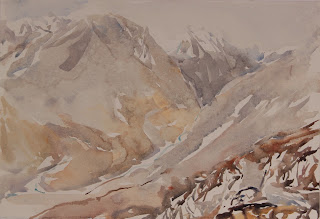

Looking into the Chenab River valley; snow coming down.

In truth the Rhotang Pass is far from this kind of isolation and adventure, but a popular attraction for Indian tourists, who pile out of cars in 1980's onesie ski suits and long fur coats, hired on the roadside for a couple hundred rupees. There are chia sellers, offers of rides on a mule or photos with a yak, but most of the visitors aim for a selfie in a snowy scene, in complete polarity to the landscapes where most of them have come from elsewhere on the subcontinent. As slightly eccentric looking Westerners with easels, paints and drawing boards we however, begin to rival this awesome backdrop in the selfie stakes. All this going on, hardly detracts from the epic panorama of deep valleys, vast peaks spun with clouds that build and fade and build with dramatic speed, sometimes clearing enough to reveal the higher peaks hidden for hours. An animated landscape, shifting, reinventing kaleidoscope, a never static, panning out on every side. We paint and draw through flurries of sleet and snow, pausing only to catch our breathe in the thin air.

Rani Nallah
Rani Nallah - Scale

16/10/17 Beas River

Beas River at the Manasula confluence

We walk up river from Manali Model this morning, over the steel girder military bridge spanning the gorge and up river from the town to where views open up towards the Solang Valley and snow capped Patalsu Peak in the North. The extent of the river torrent in wet season is made apparent by the 200m or so width of the dry boulder strewn river bed. The main dry season channel of icy clear water runs a bright cerulean blue in the pools between the torrents. The valley is narrow and wooded with mighty conifers that run up the steep valley sides. Brightly coloured farmhouses cling to the river banks and high up the steep valley on improbable terrain, precarious amongst the new build resorts and guest houses going up all around. Above the road, golden bill magpies flop from tree to tree dragging their long streaming tails, stray dogs loyally trot alongside us, dropping away at invisible boundaries. We find a way down onto the river bed, where tin roofed shacks sprawl down the banks from the road, families finding space to live below the flood line. A limping dog that tagged along a kilometre back springs in to life at the site of hens scratching up invertebrates. The commotion alerts some women washing clothes in a brackish stream at the edge of the settlement, their clothes; lime green, chilli red, fiery orange look brilliant amongst the neutral grey river bed stones. I notice for the first time, a tawny coloured cow motionless amongst the boulders behind me, a social plover reels closely overhead, griffon vultures cruise along the rising air at the edge of the ridge a thousand metres beyond. By midday it is too hot and flat bright for painting, so we wait until early evening to find a new spot at the confluence of the Manaslu river looking back up the Beas. The Seven Sisters and the 5932 metre Hanuman Tibba peak rise in the distance, snaring the first wisps of cloud seen all day, reflecting the last colours of sun light.

Friday, 13 October 2017

Delhi Rush Hour

It's 8.10pm and Delhi won't let us go. Our two taxis are jostling forward in five lanes of traffic on the Mehraui Gurgaon road, a fifth of our journey down and it's been an hour since we left Sanskriti 4km away; the bus we have booked leaves at 9.15pm. It's time for a change of plan, a quick phone call to coordinate and we divert to Haus Kaus metro station, from where we can just make the 50 minute journey to the bus station at Kashmere gate. Ground to a halt again, our drivers pulls up on the free-way, point in the direction of the metro and tell us to run, any problems call us they say.

We run between the grid locked vehicles with the flowing melee of rickshaws and mopeds, looking for a way underground. Down the escalator at the station, jam our back packs through the security -just fits, forgot my travel card, no time to cue, do what the locals do and push through to the kiosk and urgently wave notes at the attendant – it works! Onto the platform and spot the others as a train comes in and it's rush hour on the Friday before Diwali so the carriages are packed solid to the doors. When they open people push on regardless and the carriage gives way and people compress and we nearly make it but not quite, try another door. No room, We're on the verge of giving in, sweating and exhausted, desperate faces in that split second pause before the doors shut on a full carriage sealing the fate of our getaway when a gap appears and Doug miraculously steps in and I step up flattening myself enough for the doors to close, cutting of the others who mouth to us to 'hold the bus'.

The next gruelling hour on that train is a trial of contorted compressed discomfort, testing stamina and physical strength just to stay upright and on the train. In rush hour on the Delhi Metro getting on a full train does not guarantee you will stay on the train until you want to get off or that you will be able to get off when your stop comes around. This is because the density of people pushing to get off becomes a powerful force that can easily sweep you away unless you push against it. The area around the doors when this force meets the push of people wanting to get in, because no one waits for people to get off, is the most tumultuous crush area. This also where you need to be to have a choice of getting off. If were to hold the bus for the others we need to physically fight to stay by the doors and on the train to stand a chance of getting off at our stop. As we hit the busy central stations I use all my strength to resist the crush of boarding passengers, clinging to the roof rail, swaying like a battered piece of drift wood in the torrents of the Himalayan valleys we so desperately want to get to tonight. Of course everyone smiles, grins and laughs with us at the absurdity of it as we all elbow, punch and forcefully rub against each others bodies. Thankfully, enough people want to disembark at Kashmere gate with us that the torrent out-forces those getting on and we are safely jettisoned onto the platform.
Five minutes before the bus leaves I'm elected to run on ahead, leaving Doug to run with the bags. Up the escalator and I'm immediately lost, no time to decipher signs I ask everyone at every turn where the bus station is. Up and out the station onto the street, I keep asking and soon people are pointing the way before I get to them. The buses are hidden under a multi storey car park so I need this help, people keep pointing shouting when I go the wrong way. I am so literally relying on there waving arms that I end up at one point jumping over a wall I am pointed at, straight into a police man. We hesitate as he calculates my offence, sees the desperation behind my sheepish grin and with a disapproving shake of the head releases me. I speed walk a few paces out of respect, then sprint to the security. Bag through and into the concourse – I look in dismay at the departure board, I cannot decipher the Hindi script but can see the time of our bus is not there. Another man wants to help me, he wants to show me the bus but I ask him to point, only 2 minutes to go. There are bus stands everywhere but I ask enough people that I find our Manali bus pulling out and manoeuvring like they do in eagerness to leave. The conductor is still on the ground and he says no problem to waiting five minutes when I ask, knowing the others will need ten at least. My Indian phone runs out of credit, so I can't direct the others. I go looking back to the escalator, concourse, departure board but nothing, it's too soon. Back to the bus plead for five more minutes, bus driver this time, angry, 'no waiting for passengers' as he climbs into the cab. I think the conductors more sympathetic, its an eleven hour journey to Manali after all, what's 15 minutes now. Even so, I doubt he can override the driver, chomping at the bit to get stuck into the traffic.

The others must be lost, I run for one last look doubting the driver will wait, then I spot them jogging along the stands, I shout and wave, there going towards the bus which is pulling out, I run back, bang on the drivers window and he stops, boot opens, our bags are on. All five of us have made it, sweating, exhausted, bruised and unprepared for an 11 hour bus ride. After beating the Delhi rush hour however, we gratefully savour every traffic jammed, pot holed, precipitous verged, blind bend overtaking moment of the journey North to Manali. I get a call, it's our taxi driving to 'thank god we made it'.

Thursday, 12 October 2017

Delhi Birds


Black kites, Meena

Returned to Jama Masjid to look for the black kites and find out more about if and why they congregate in this area. I walk around the mosque, on each side is an entrance, each slightly different; North side is where coach loads of tourists enter, East overlooks the Bazaar where people meet and chat on the way up the steps. South is on the road where car parts are sold and the auto rickshaws park up forcing pedestrians to walk with the traffic. A teenager is chasing a younger boy around the steps with a belt then lashes out a stray dog, a beggar is ignored, a small girl slips her hand from her mothers so she can skip in and out of the unmanned security gate at the entrance. Across the road is Kalan Mahal street, mainly butchers shops and restaurants preparing mutton and chicken. This seems the most likely source of waste to attract the kites.

I head back to the South side and into the bizarre that leads away from the mosque and along the wasteland, Meena Park, where the kites are flocking. The ground is hard and washed out umber with a weak fringe of grass tufts smothered with dust and building debris. Trees on the far side shade a small group of figures. The walled bank rises 20 metres to the street, cubes of aerial laced flats jostle higher still into a smoggy smudge. A dumper vehicle is parked, a man changes into a shalwar kameez and another paces in wide strides throwing his arms in the air grinning and proclaiming his views to the sky. Children and elderly men watch me draw, discussing my progress and arguing over which bit of the scene I am currently drawing. A woman in a sari, her child perched on the wall above me, physically follows my hand from paint box to paper, leaning in and out or rifles though the pages of my sketchbook whenever she can. One word I recognise is repeated over and over around me, 'cheel' the name for black kite in Hindi and Urdu, it seems to please the onlookers that I am drawing their birds, they admire them too I think. The cheels cousin the red kite was extinct in London by 1600 and almost nation wide until the hugely successful reintroduction programme brought them back.

As I finished drawing, a man approached me who I could question about the reason for the kites and confirmed that this area was used as a dump. The dumper moves and the flock draws in, magnetised to this visual cue. The bucket is empty though and the flock moves away expanding outwards, but without disipating. I wonder why there is no rubbish on this dump unless it is specific to meat in which case the kites play an important role in the city's sanitation. And will I find out anything about the man I saw from a distance feeding the kites?

Back at Sanskriti, sticky dust of the city washed away with a bucket, I find a spot in the garden to enjoy the final glow of orange light you get here in the evenings. Still trees turn quickly to silhouettes, flecks of leaves sprinkled across the subdued sky. A crooked spindly shape breaks the silhouettes in ungainly flight. Another one a few minutes later; two grey hornbills going to roost in a tall fig tree behind the abandoned house.

Grey hornbill, dusk at Sanskriti Kendra


(Vashiel)